Notary Public in Thailand — Frequently Asked Questions
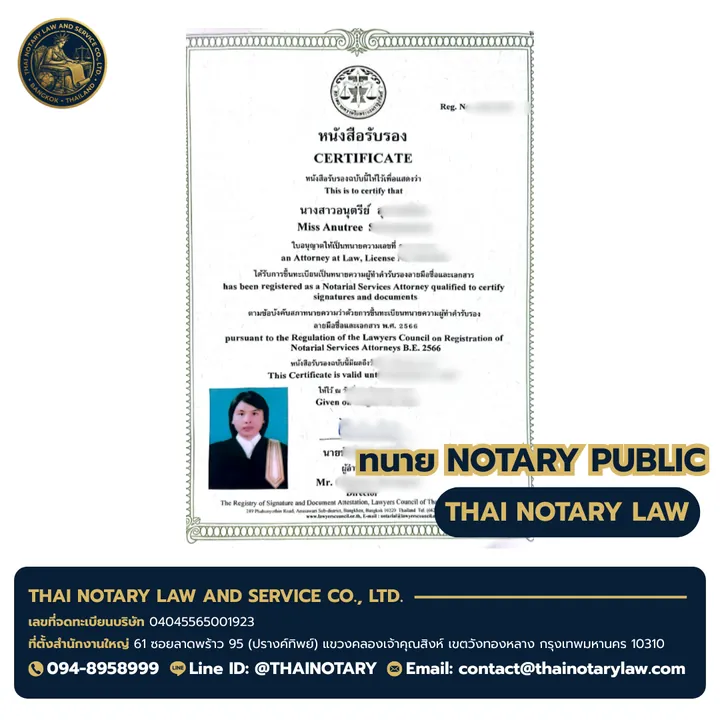
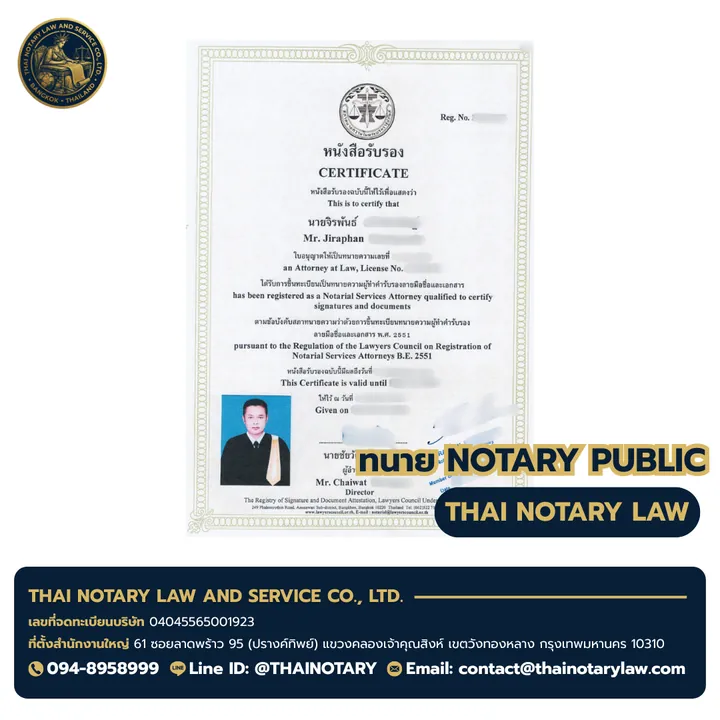
Thailand has no civil-law notary office. Notarisation is performed by a Notarial Services Attorney licensed by the Lawyers Council of Thailand under the 2003 regulation. The answers below are written by the attorneys who handle these files daily; figures are estimates current as of August 2026 and the receiving authority always sets the final requirement.
Does Thailand have a Notary Public in the usual sense?
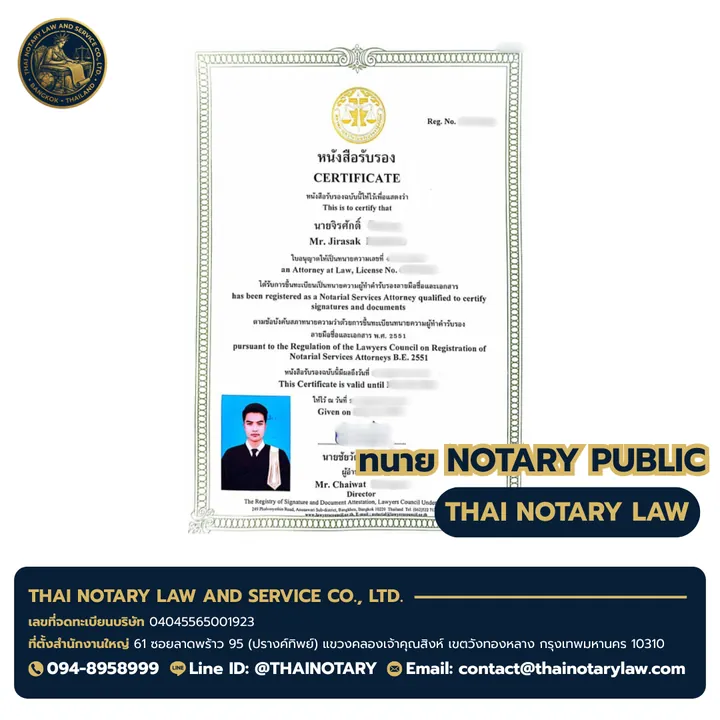
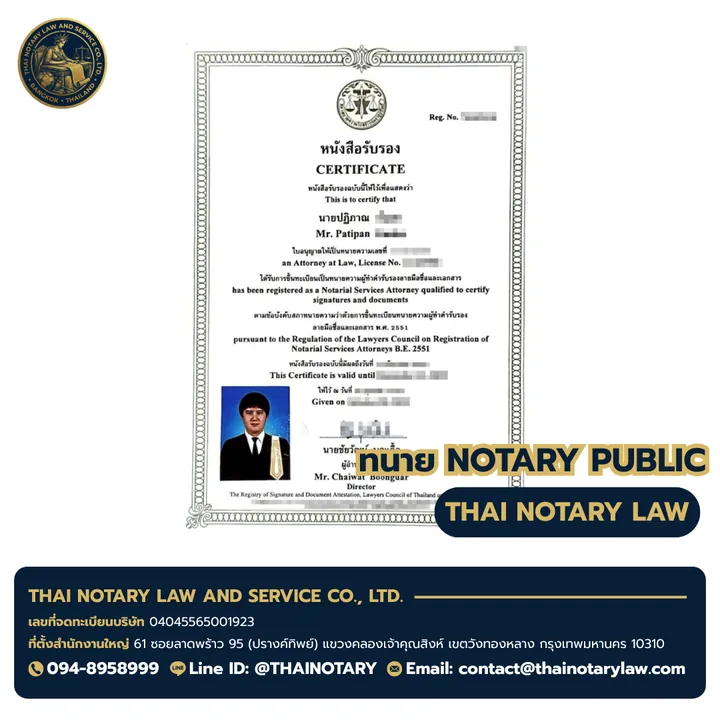
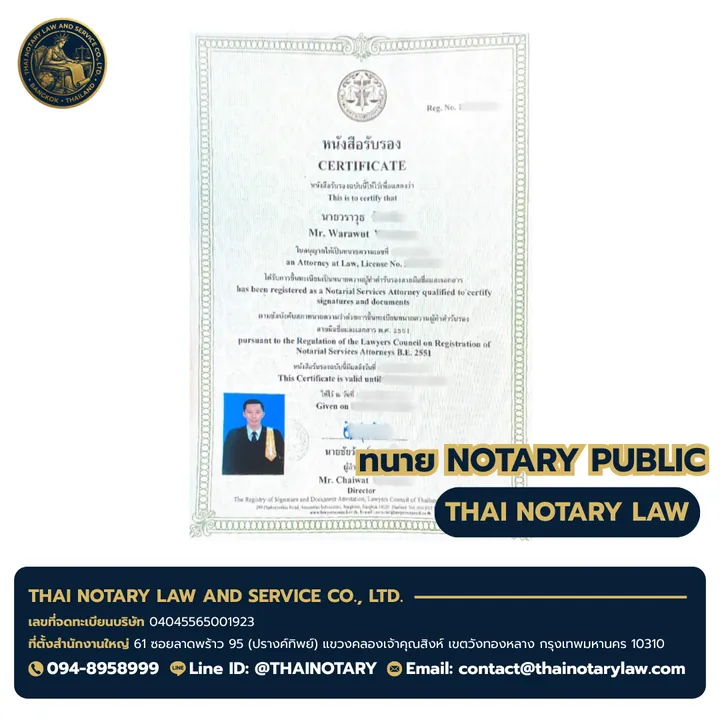
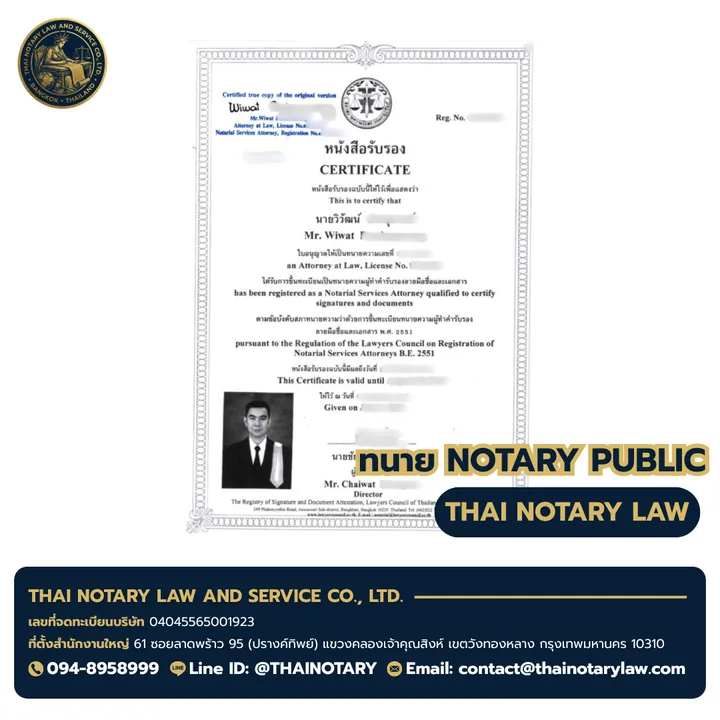
Answer: No. Thailand is a civil-law country without a separate notary profession. Instead, the Lawyers Council of Thailand licenses practising attorneys as Notarial Services Attorneys under its 2003 regulation. Such an attorney may witness and certify signatures, certify true copies, administer oaths and affirmations and witness the execution of contracts. Their licence number is on the public register and can be quoted to the receiving authority.
What exactly does the notarial certificate confirm?
Answer: It confirms process, not truth. The attorney records that a named person, identified by passport or Thai ID, signed the document in the attorney's presence on a stated date, or that a copy was compared against an original that was produced. It does not confirm that the statements in the document are correct, nor that the transaction is legally effective in the destination country.
Do I have to attend in person?
Answer: For signature witnessing, affidavits and oaths, yes — the signer must be physically present so identity can be checked and the signature observed. For certified true copies the original document must be produced, but a representative may bring it if you provide written authorisation. Remote notarisation by video is not recognised for Thai notarial acts.
What identification is accepted?
Answer: A valid passport for foreign nationals, or a Thai national ID card for Thai citizens. The name on the identification must match the name in the document; where earlier documents use another spelling or a former name, bring the change-of-name certificate or marriage certificate so the discrepancy can be recorded in the certificate itself.
Is notarisation alone enough for use abroad?
Answer: Rarely. Most foreign authorities want the chain completed: notarisation by the attorney, then legalisation by the Department of Consular Affairs of the Thai Ministry of Foreign Affairs, then legalisation by the embassy or consulate of the destination country in Bangkok. Some universities, banks and private counterparties accept the notarial certificate on its own — ask them in writing before paying for extra steps.
What does MFA legalisation cost and how long does it take?
Answer: The Department of Consular Affairs charges an official fee of 200 THB per document for standard service, with collection normally on the second business day, and 400 THB per document for express same-day service. Those are government fees, separate from attorney or courier charges, and the MFA may revise them.
When will Thailand's apostille replace this chain?
Answer: Thailand acceded to the 1961 Hague Apostille Convention in June 2026 and the Convention enters into force for Thailand on 28 February 2027. Until that date the consular legalisation chain described above still applies. After entry into force, documents destined for other Convention States will need a single apostille instead of embassy legalisation, but the destination country may still require a translation and, for private documents, notarisation first.
Can the attorney notarise a document written only in Thai?
Answer: Yes, but a document going abroad is usually paired with an English translation. The safest structure is a bilingual or dual-column document, or a Thai original with a certified translation attached and referenced in the notarial certificate so both instruments travel as one bundle.
Can a power of attorney be notarised for property or company matters?
Answer: Yes. A power of attorney for a Thai Land Office transfer, a company registration, a bank account or a court matter can be signed before the attorney and notarised. The critical point is that the wording must satisfy the receiving body: Land Offices, the Department of Business Development and individual banks each have their own expectations, and a generic template is the most common cause of rejection.
What are the most common reasons a notarised document is rejected abroad?
Answer: Three dominate. First, the chain is incomplete — notarisation without MFA and embassy legalisation. Second, an identity mismatch between the passport spelling and the document. Third, an expired or stale underlying record: police clearances, house registrations and bank confirmations are often required to be under three to six months old at the date of lodgement.
How much does notarisation cost and how fast is it?
Answer: Our attorney fee depends on the act requested and is quoted before we start — contact us by phone, LINE or email for a written quote. Most in-office appointments are completed the same day, often within one to two hours. Where MFA and embassy steps follow, allow a further three to ten business days in total, driven mainly by the embassy's own appointment queue rather than by our office.
Can you handle the whole chain if I am outside Thailand?
Answer: Partly. Certified copies, MFA legalisation and embassy submission can be handled by our office with your authorisation and couriered originals. Any act requiring your signature must be executed in person in Thailand, or alternatively before a notary or a Thai embassy in the country where you are, which then follows that country's own legalisation route.
Not sure which certification your document needs?
Send a scan and the name of the receiving authority; we confirm the exact chain, cost and lead time before any work starts.
Primary sources: Lawyers Council of Thailand (notarial services regulation), Department of Consular Affairs, Ministry of Foreign Affairs of Thailand, and the HCCH status table for the 1961 Apostille Convention.
General information only, not legal advice, and no outcome is guaranteed. Requirements change — confirm with the authority that will receive your documents.