Thailand keeps no state register of sworn translators. A translation leaving Thailand is authenticated through the Department of Consular Affairs of the Ministry of Foreign Affairs, which certifies the signature and seal chain rather than the wording itself. The answers below reflect practice as of August 2026; fees and lead times are estimates and the receiving authority sets the final requirement.
Is there such a thing as a sworn translator in Thailand?
Answer: No. Unlike Germany, France, Spain or Indonesia, Thailand has no court-appointed sworn translator register. A Thai translation gains official weight in two other ways: a certificate of accuracy issued by the translation company or translator, and — for documents leaving Thailand — legalisation of the translation by the Department of Consular Affairs of the Ministry of Foreign Affairs. When a foreign authority asks for a 'sworn translation', it normally means the MFA-legalised route, or a sworn translator appointed in that country.
When does my translation actually need MFA legalisation?
Answer: Whenever a foreign government body will act on the document: visa and immigration files, marriage registration abroad, university admission, professional licensing, company registration, court filings and property transactions. Private uses — an employer's HR file, a school application that only asks for a certified copy, an internal audit — usually accept a company certificate of accuracy. Ask the receiving office in writing which level it requires before paying for the chain.
What does the Department of Consular Affairs charge and how long does it take?
Answer: The MFA fee is 200 THB per document for the normal service, with collection normally on the second business day, and 400 THB per document for the express same-day service. Those are official government fees, separate from translation and courier costs, and the MFA may change them. Volume, document condition and queue length at Chaeng Watthana all affect real turnaround, so plan a working-day buffer rather than counting on the minimum.
Can Thailand issue an apostille yet?
Answer: Not yet. Thailand deposited its instrument of accession to the 1961 Hague Apostille Convention in June 2026 and the Convention enters into force for Thailand on 28 February 2027. Until that date every Thai document destined for a Convention country still follows the traditional chain: translation, MFA legalisation, then legalisation by the destination country's embassy or consulate in Bangkok. Confirm the current status with the Department of Consular Affairs before you file.
Does the embassy step disappear once apostille starts?
Answer: For Convention member states the apostille is designed to replace embassy legalisation for public documents. Non-member destinations — several Middle Eastern and a few Asian jurisdictions — will still require embassy legalisation. Some receiving institutions also keep their own internal rules, for example insisting on a translation produced in their own country. Treat the apostille as replacing one step in the chain, not as replacing translation or the destination authority's discretion.
Is a NAATI translation useful for documents used inside Thailand?
Answer: Generally no. NAATI is the Australian certification body, and its stamp is what the Department of Home Affairs, Australian universities and state agencies expect. Thai district offices, immigration and courts do not recognise NAATI as a domestic certification; they want a Thai translation whose accuracy is certified and, where the document is foreign, legalised through the MFA. Use NAATI for the Australia-bound direction and the consular route for the Thailand-bound direction.
What is the correct order for a foreign document I need to use in Thailand?
Answer: Authenticate first, translate second. The document is certified in the issuing country (notary, then the competent authority or that country's foreign ministry), then legalised by the Royal Thai Embassy or Consulate there when the apostille route is unavailable. Only then is it translated into Thai and the translation legalised by the Department of Consular Affairs. Translating before authentication is the single most common reason a file has to be redone from scratch.
How fresh does a civil registration document have to be?
Answer: Most destination authorities want a certified extract issued within three to six months, and some embassies apply the tighter three-month rule to marital status and police clearance certificates. Because the whole chain can consume two to three weeks, request the fresh extract from the district office first and start the clock from that date. An extract that expires while it waits in an embassy queue cannot be rescued — the chain restarts.
Why do embassies reject otherwise correct translations?
Answer: The recurring causes are name spellings that differ from the passport, translating from an uncertified photocopy instead of a fresh certified extract, omitting the back page, stamps or handwritten annotations, document or registration numbers that do not match the original, staples removed so a seal no longer bridges the pages, and an expired source extract. Each of these is a formal defect the reviewing officer can raise without assessing the translation itself.
Do you translate directly between two foreign languages?
Answer: For most pairs we route through English or Thai, and that is usually what the receiving authority prefers because it can verify the pivot text. Where a destination insists on a direct pair — for instance a Japanese document for a Korean ministry — we confirm in advance whether that authority accepts a pivot version, since redoing the chain later costs far more than checking first. Tell us the destination office by name and we scope the pair accordingly.
Not sure which certification your document needs?
Send a scan plus the name of the authority that will receive the file. We confirm the exact chain, estimated cost and lead time before any work begins.
094-895-8999 · LINE @Thainotary
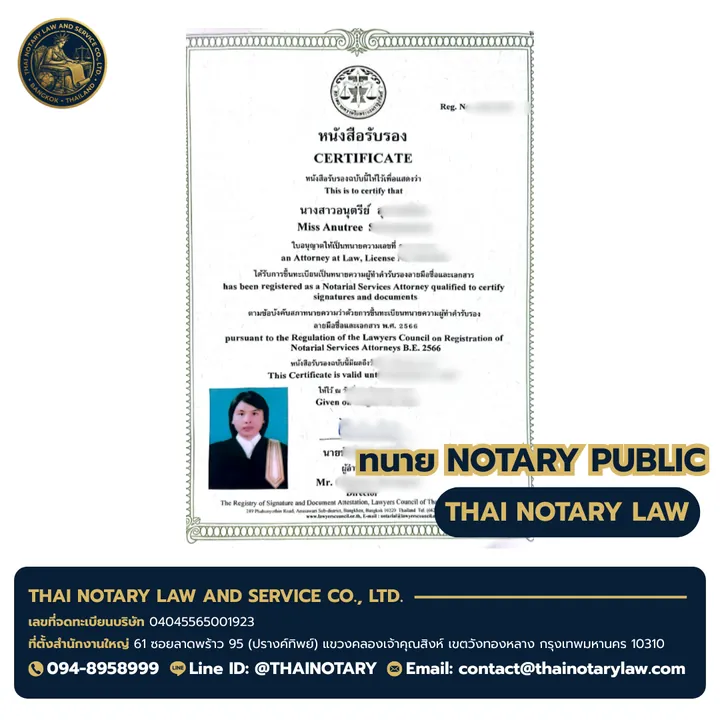
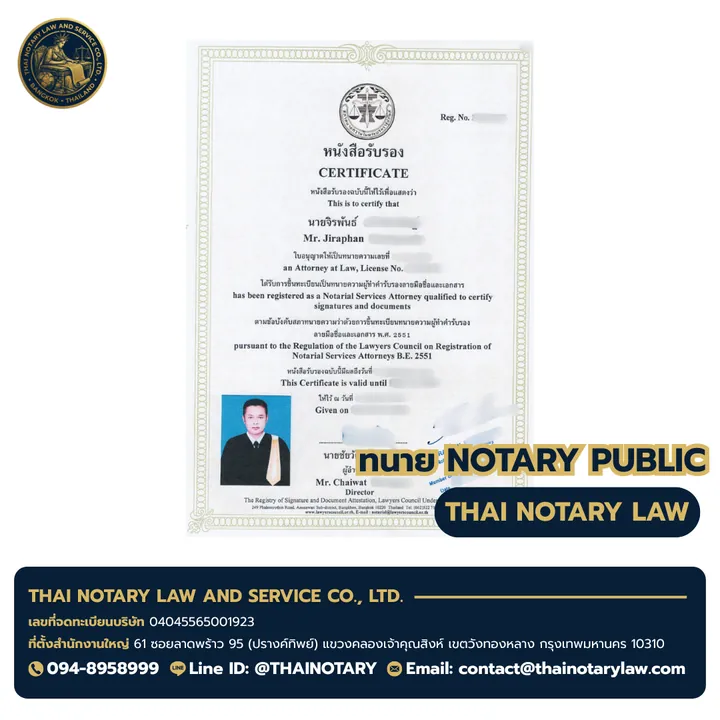
Primary sources: Department of Consular Affairs, Ministry of Foreign Affairs of Thailand; HCCH status table for the 1961 Apostille Convention; NAATI (Australia); Lawyers Council of Thailand notarial services regulation.
General information only, not legal advice, and no outcome is guaranteed. Requirements change — confirm with the authority that will receive your documents.